
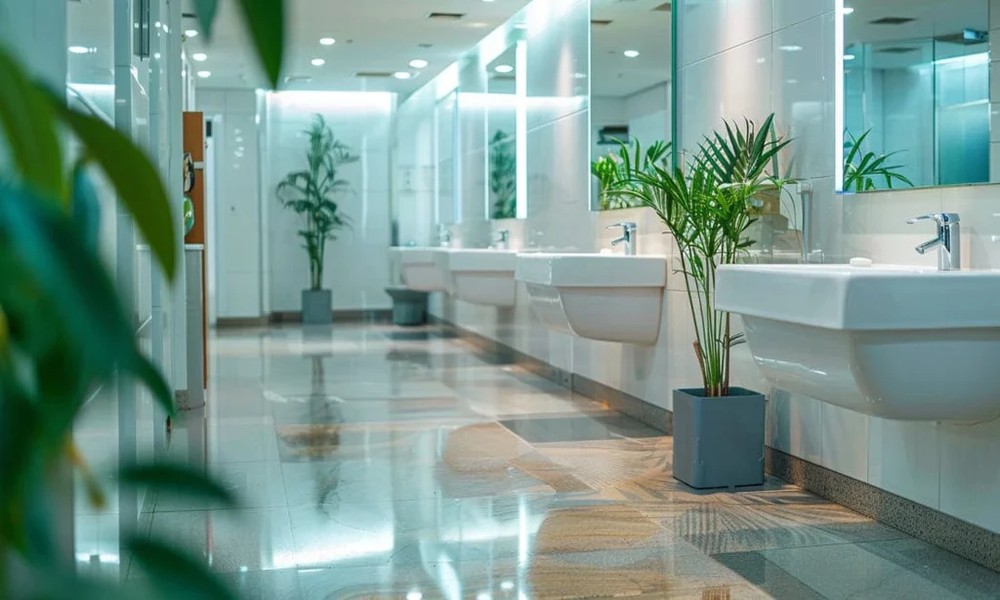

Restroom quality is among the top 3 drivers of occupant satisfaction scores in post-occupancy evaluations across commercial office, education, and healthcare sectors. Facility managers who treat restroom accessories as a commodity specification routinely underperform peers who treat the restroom environment as a measurable contributor to building performance metrics.
What Does the Research Say About Restroom Quality and Tenant Satisfaction?
BOMA International’s Building Experience Survey has consistently ranked restroom quality among the top 3 factors affecting tenant satisfaction in Class A office buildings. In 2023, 67% of commercial tenants who cited dissatisfaction with their building named restroom quality as a contributing factor, outranking HVAC performance and elevator wait times.
In K-12 education settings, restroom condition is among the strongest predictors of 2 measurable outcomes:
- Vandalism rates on restroom fixtures and accessories
- 5-year maintenance cost escalation across the facility
How Does Accessory Durability Affect Total Cost of Ownership?
Initial product cost represents a fraction of total accessory lifecycle cost when maintenance, replacement, and downtime are factored in over a 15 to 25-year service period.
Stainless steel accessories at commercial-duty gauge specifications outperform residential-grade alternatives in high-traffic applications across 3 measurable dimensions:
- Service life: 15 to 25 years versus 5 to 8 years for residential-grade alternatives
- Replacement frequency: 1 to 2 replacements versus 3 to 5 over a 25-year building lifecycle
- Maintenance call reduction: fewer mechanical failures in commercial-duty internal mechanisms
Facility managers specifying replacements for high-traffic restrooms are increasingly selecting commercial washroom accessories with integrated warranty programs and documented replacement part availability.
Does WELL Certification Include Restroom Requirements?
Yes. WELL Building Standard certification includes provisions for hand hygiene accessibility and restroom design under the Nourishment and Hygiene concepts. These provisions directly reference accessory placement and operation standards in ways that align with ADA reach range requirements.
Buildings pursuing WELL alongside LEED certification benefit from specifying accessories that satisfy both frameworks simultaneously, since the material and accessibility documentation requirements overlap significantly across the two standards.
When Should Facility Managers Be Involved in Accessory Specification?
Facility managers who are consulted during design development consistently report higher satisfaction with long-term maintenance outcomes than those who inherit specifications made without operational input. 3 specification decisions benefit most from facilities input:
- Dispenser capacity relative to projected daily usage and service frequency
- Cartridge format compatibility with bulk supply storage room dimensions
- Touchless versus manual hardware based on the facility’s maintenance staffing model
